
 Table of Contents
 Is Your Phishing Awareness Program Actually Working?
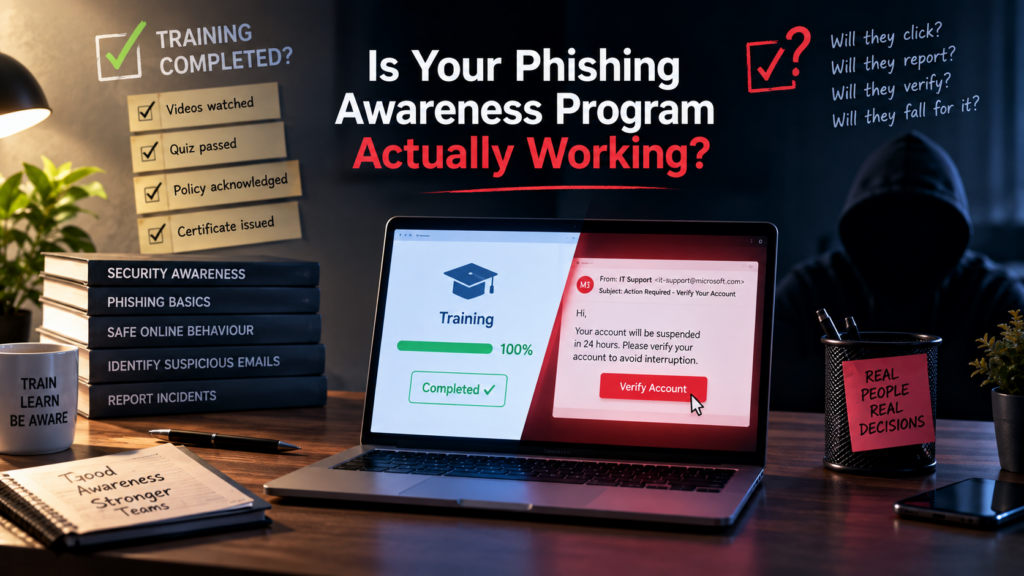
Your employees completed their phishing awareness training.
They watched the videos, attended the sessions, passed the quizzes and perhaps even acknowledged the security policy.
So, is your organization better protected against phishing?
Maybe. But how do you know?
This is the question many organizations do not ask.
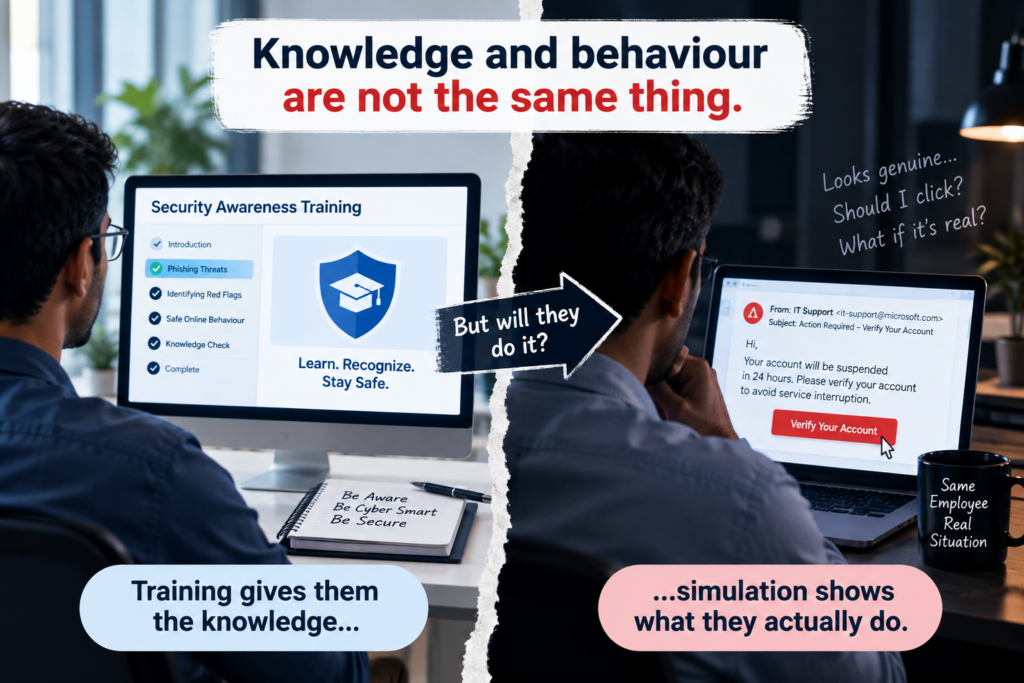
Training can tell you whether employees have been exposed to security information. It can measure completion and knowledge. But it cannot reliably tell you how employees will behave when a convincing phishing email appears in their inbox.
And that is where measuring the effectiveness of your phishing awareness program becomes important.
Completion Is Not Effectiveness
Imagine an organization where 98% of employees have completed their annual phishing awareness training.
That sounds successful.
But consider what happens next.
An employee receives an email that appears to come from Microsoft 365. Another receives an urgent request from their manager. Someone in Finance receives a supplier invoice. Another employee receives a password-expiry notification.
These messages look familiar. They arrive during a busy workday. They create urgency and appear relevant to the employee’s job.
What will they do?
Training completion cannot answer that question.
A quiz can tell you whether an employee knows that suspicious links are dangerous.
It cannot tell you whether that employee will recognize a realistic phishing attempt when they are busy, distracted or under pressure.
What Should an Effective Program Measure?
A stronger phishing awareness program should measure behaviour, not just participation.
For example:
- How many employees clicked a simulated phishing link?
- How many reported the message?
- How many attempted to submit credentials?
- Which departments are more susceptible?
- Are the same employees repeatedly making risky decisions?
- Are employees improving after receiving training and feedback?
- Are reporting rates increasing over time?
These measurements provide a much clearer picture of organizational readiness.
The goal is not simply to achieve a low click rate in one campaign.
The goal is to see measurable improvement over time.
Establish a Baseline
This is where phishing simulation becomes particularly valuable.
Before deciding whether an awareness program is working, you need a baseline.
Run a controlled phishing simulation and observe the results.
Perhaps 14% of employees click.
That number is not necessarily a failure. It is your starting point.
Now provide appropriate awareness training and feedback.
Run another simulation later.
If the click rate falls to 8% and the reporting rate increases, you have evidence that behaviour is changing.
Run it again.
If the organization continues to improve, you have something much more meaningful than a training completion percentage.
You are measuring progress.
Why One Phishing Simulation Is Not Enough
A single simulation is only a snapshot.
Employees may perform well because they recently completed training. They may become familiar with the simulation format. Or they may simply have been more cautious that particular day.
Real phishing does not happen once a year.
Attackers continually change their approaches, themes and techniques.
Your testing should therefore be continuous as well.
Periodic simulations help organizations understand whether secure behaviour is becoming a habit rather than a temporary response to training.
The cycle should look something like this:
Train → Simulate → Measure → Educate → Retest → Improve
Then repeat.
Make the Simulations Realistic
Effectiveness also depends on what you test.
If every simulation is an obviously fake email with poor grammar and a suspicious-looking link, employees may learn how to pass the test rather than how to identify real attacks.
Simulations should reflect the situations employees are likely to encounter.
For example:
- Microsoft 365 notifications
- Password reset requests
- HR communications
- Supplier invoices
- Cloud document sharing
- Executive requests
- Collaboration platform messages
- MFA or account verification requests
Different scenarios can also be used for different departments.
Finance may face invoice fraud scenarios. HR may encounter employee-document requests. IT teams may receive account or technical-support scenarios.
This makes the assessment more relevant and provides better insight into where risk actually exists.
The Goal Is Not to Catch Employees
Phishing simulation should never become an exercise in embarrassing employees who click.
The objective is to identify weaknesses before an attacker does.
A click on a simulated email creates an opportunity to learn.
Repeated clicks may indicate that additional intervention is required.
Successful reporting demonstrates positive behaviour.
Improvement between simulations demonstrates that the awareness program is working.
This is why simulation should be treated as part of the learning process, not as a separate activity.
So, Is Your Program Working?
If your answer is based only on training completion, quiz scores and attendance, you may know how much training was delivered.
You may not know how much behaviour changed.
A more effective approach is to continuously test, measure and improve.
Training creates awareness.
Simulation measures behaviour.
Feedback changes behaviour.
Periodic retesting shows whether the change is lasting.
Ultimately, the question every organization should be able to answer is simple:
If a realistic phishing email reaches our employees tomorrow, do we have evidence that they will make the right decision?
If you don’t have that evidence, your phishing awareness program may be educating employees — but you don’t yet know how effective it really is.
Phishing simulation provides a practical way to find out.
Because the real measure of security awareness is not what employees know. It is what they do.
