
 Table of Contents
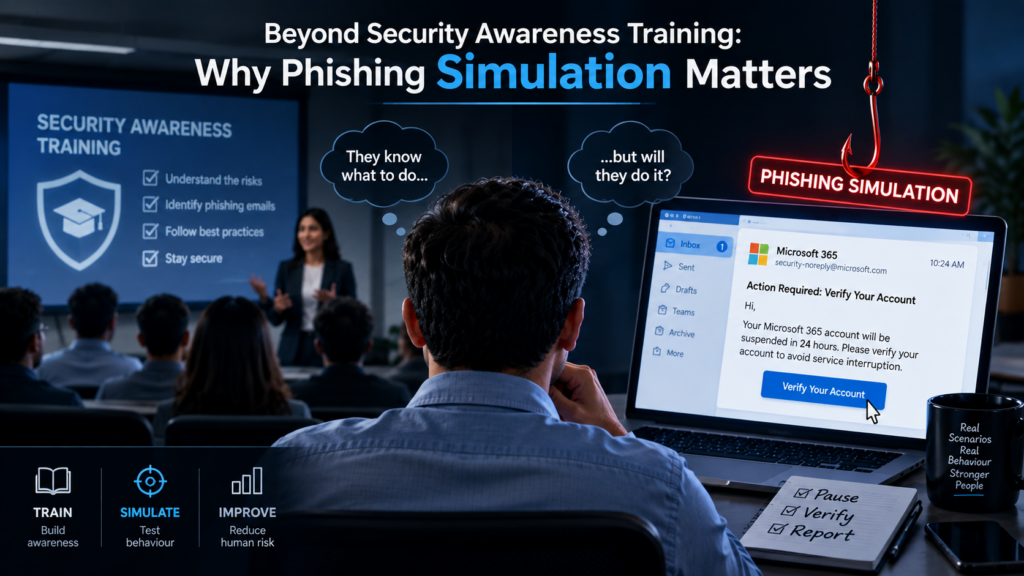
 Beyond Security Awareness Training: Why Phishing Simulation Matters
Your employees completed their security awareness training.
They watched the videos. They read the examples. They passed the quiz. Your dashboard shows 98% completion.
But there is one question the training report cannot answer:
What will they actually do when a convincing phishing email arrives?
This is where security awareness training reaches its limit. Training is important, but knowing what to do and doing it when under pressure are two different things.
Training Creates Awareness. It Doesn’t Prove Readiness.
Security awareness training gives employees the knowledge they need to recognize and respond to common security threats.
It can teach them to:
- Identify suspicious emails
- Avoid unknown links and attachments
- Protect their passwords
- Use MFA correctly
- Verify unusual requests
- Report suspicious activity
All of this is necessary.
But training generally measures knowledge and completion.
Phishing attacks test something different: behaviour.
An employee may know that phishing emails are dangerous and still click a link when the email appears to come from their manager, a trusted supplier, HR, Microsoft 365, or another familiar service.
That is the gap organizations need to understand.
Phishing Simulation Tests What Training Cannot
A phishing simulation creates a controlled version of a real-world phishing situation.
Instead of asking employees whether they know how to identify phishing, you observe what they do when they receive a realistic simulated attack.
For example, a simulation could look like:
- A Microsoft 365 account notification
- A password-expiry message
- An HR or payroll request
- A supplier invoice
- A document-sharing notification
- A request apparently sent by a senior executive
- An unexpected MFA or account-verification request
The objective is not to trick employees for the sake of tricking them.
The objective is to understand how people respond to realistic pressure.
That provides information that a training completion report cannot.
From Completion Rates to Behavioural Risk
Consider these two reports:
Report A
97% of employees completed security awareness training.
Report B
11% clicked the simulated phishing email.
6% entered credentials.
34% reported the email.
Finance had the highest click rate.
Repeat clickers reduced their failure rate after targeted coaching.
Which report tells you more about your organization’s human risk?
Training completion tells you that employees received the training.
Simulation data tells you how they behaved.
This is why phishing simulation should not be treated as another checkbox in the security awareness program. It should be used as a measurement and improvement mechanism.
A Simulation Should Not End With a Click
A common mistake is to treat the simulation as a simple test:
Send email → employee clicks → record failure → campaign ends.
That misses the real opportunity.
A stronger approach is:
Simulate → Observe → Educate → Coach → Retest → Measure
If an employee clicks, the response should help them understand what happened and what they should have looked for.
Employees who repeatedly demonstrate risky behaviour can receive targeted intervention.
The organization can then run another simulation and determine whether behaviour has changed.
Over time, the question becomes more meaningful:
Are our employees becoming harder to phish?
Realistic Simulations Matter
Phishing simulations are only useful if they reflect the threats employees are likely to encounter.
A program built entirely around obvious messages such as fake prizes and suspicious grammar may teach employees to recognize the simulation rather than recognize phishing.
Modern simulations should reflect real business communication.
They can include scenarios involving:
- Cloud applications
- Collaboration platforms
- Finance and invoices
- HR communications
- Vendors and suppliers
- Password and account notifications
- Executive requests
- MFA and authentication
The goal is not to make simulations unnecessarily difficult.
It is to make them relevant enough to test real decision-making.
The Goal Is Behaviour Change
The ultimate objective of a phishing simulation program is not simply to achieve a lower click rate.
It is to create a stronger security behaviour:
Pause. Verify. Report.
A mature program should therefore look at more than clicks.
It should measure:
- Click rate
- Credential submission
- Reporting rate
- Repeat failures
- Improvement after training
- Risk by department
- Response to different scenarios
- Behavioural trends over time
This turns phishing simulation from an awareness exercise into a continuous feedback loop.
Training and Simulation Work Together
This is not a choice between security awareness training and phishing simulation.
You need both.
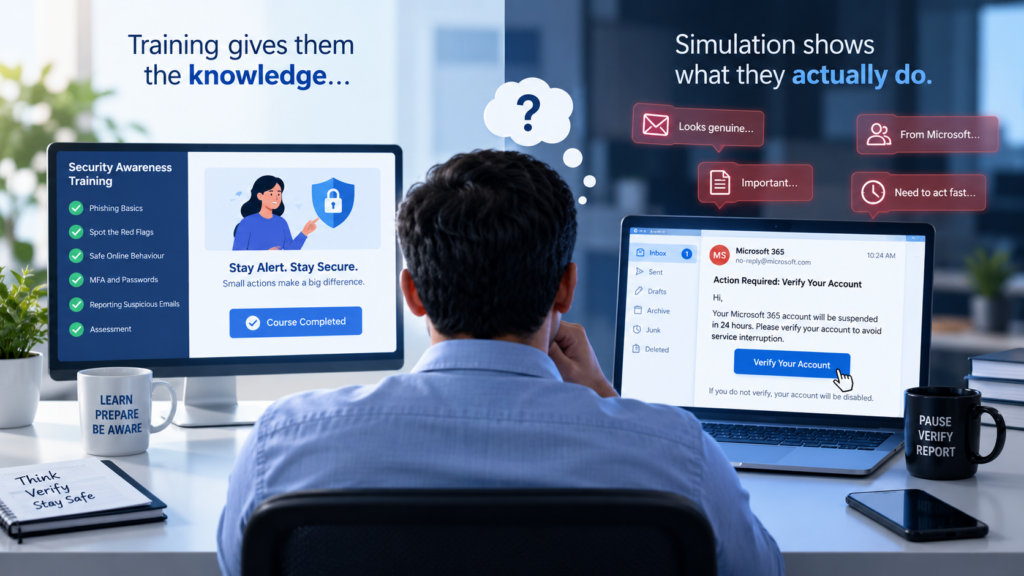
Training tells employees what they should do.
Simulation shows what they actually do.
Feedback helps change the behaviour.
Repeated simulation shows whether that change lasts.
Organizations that want to reduce human-related cyber risk therefore need to look beyond training completion.
Because when a real phishing email arrives, there will be no training video telling the employee what to click.
There will only be a decision.
You cannot measure phishing readiness by asking employees whether they understand phishing. You measure it by observing what they do when phishing looks real.
Organizations looking to establish this kind of continuous testing can use phishing simulation services such as those provided by Valency Networks to assess employee behaviour, identify high-risk areas and measure improvement over time.
