
Network Vulnerability Assessment forms the foundation of effective network security testing. This feature systematically identifies security weaknesses across servers, network devices, firewalls, operating systems, and communication protocols. By uncovering misconfigurations, outdated software, and known vulnerabilities, organizations gain visibility into risks that could impact business operations and sensitive data.
Network Penetration Testing Services go beyond vulnerability discovery by actively validating whether identified weaknesses can be exploited. Security experts simulate real-world attack techniques to evaluate network resilience, helping organizations understand the actual business impact of security gaps and prioritize remediation efforts effectively.
Modern network environments constantly evolve as new systems, applications, and users are added. Network VAPT Services help organizations identify emerging security risks, monitor changing attack surfaces, and maintain a proactive approach to cybersecurity risk management and infrastructure protection.

Network VAPT Services provide comprehensive coverage across critical network components, security controls, and infrastructure assets. These capabilities help organizations identify vulnerabilities, validate defenses, and strengthen their overall security posture.

Valency Networks has established a proven track record of delivering exceptional network security services to clients across various industries. Our team of seasoned cybersecurity professionals brings extensive experience and expertise to every engagement, ensuring the highest quality of service and results that exceed client expectations.

Overall, network pentesting offers organizations a comprehensive and realistic assessment of their network security posture, helping them identify vulnerabilities, assess risks, and strengthen their defenses against cyber threats effectively. By partnering with experienced pentesting providers, organizations can leverage their expertise and insights to enhance their cybersecurity posture and protect their digital assets.
Network security testing delivers measurable security and operational benefits that support risk management, compliance initiatives, and business continuity objectives.
By identifying vulnerabilities before threat actors can exploit them, organizations can proactively reduce the likelihood of data breaches, ransomware incidents, and unauthorized access.
Many regulatory frameworks require organizations to conduct periodic security assessments. Network VAPT Services help support compliance efforts through structured testing and documented risk evaluations.
Strong network security reduces the likelihood of disruptions caused by cyber incidents. Organizations benefit from improved operational resilience and reduced downtime risks.
Assessment findings provide actionable insights that help organizations prioritize remediation efforts, allocate resources efficiently, and focus security investments on the most significant risks.
Network penetration testing is a critical component of effective cybersecurity strategies, helping organizations identify vulnerabilities, assess security controls, and meet compliance requirements. Expert network VAPT companies play a crucial role in solving this problem by providing specialized expertise, advanced tools and techniques, comprehensive analysis and reporting, and continuous support and guidance. By collaborating with expert companies, organizations can strengthen their cybersecurity defenses, mitigate the risk of cyber threats, and safeguard their digital assets effectively.
Organizations face a wide range of network-based threats that can expose sensitive information, disrupt operations, and increase cybersecurity risks. Network VAPT Services help identify and mitigate these threats before they become security incidents.

Improperly configured routers, switches, and firewalls can create unauthorized access paths, expose internal services, and weaken overall network security controls. These configuration weaknesses are frequently exploited by attackers to bypass security restrictions and gain unauthorized network access. Regular configuration reviews and security assessments help organizations identify and correct these issues before they can be abused.
Outdated operating systems, applications, and network device firmware often contain publicly known vulnerabilities that attackers actively target during intrusion attempts. Delayed patch management increases the likelihood of successful exploitation and potential business disruption. A proactive vulnerability management program helps reduce exposure to known security threats and emerging attack techniques.
Incorrect firewall rules may unintentionally expose sensitive services or allow unauthorized traffic into critical network segments.
Weak routing policies and default settings can create security gaps that attackers may leverage to access internal resources.
Improper switch configurations can enable unauthorized device connections, VLAN hopping attacks, and network traffic interception.
Unsupported operating systems no longer receive security updates, making them attractive targets for cybercriminals.
Outdated firmware on routers, switches, and firewalls can contain exploitable flaws that compromise network security.
Organizations that postpone critical updates may remain exposed to high-risk vulnerabilities for extended periods.
Our Network VAPT process at Valency Networks encompasses pre-assessment planning, information gathering, vulnerability identification, exploitation and penetration testing, analysis and reporting, and post-assessment support. By following these stages, we deliver comprehensive VAPT services tailored to the unique needs and challenges of our clients, helping them strengthen their network security defenses and mitigate the risk of cyber threats effectively.
Banks, financial institutions, and fintech organizations use Network VAPT Services to secure payment systems, customer data, transaction networks, and regulatory compliance environments.
Healthcare providers rely on network security assessments to protect patient information, medical systems, healthcare applications, and interconnected clinical environments.
Technology companies use Network Vulnerability Assessment and Penetration Testing to secure development environments, cloud connectivity, customer platforms, and internal infrastructure.
Retail organizations benefit from network security testing that protects payment processing systems, customer information, inventory platforms, and business operations.
Manufacturing businesses use Corporate Network Penetration Testing to identify vulnerabilities within production networks, industrial systems, and connected operational environments.
Government agencies and public sector organizations conduct Network Security Assessments to protect sensitive information, citizen services, and critical infrastructure systems.
Our Network VAPT process at Valency Networks encompasses pre-assessment planning, information gathering, vulnerability identification, exploitation and penetration testing, analysis and reporting, and post-assessment support. By following these stages, we deliver comprehensive VAPT services tailored to the unique needs and challenges of our clients, helping them strengthen their network security defenses and mitigate the risk of cyber threats effectively.
Organizations require more than automated vulnerability scanning to effectively manage cyber risks. Professional Network VAPT Services provide deeper security insights, real-world attack validation, and actionable remediation guidance that strengthen overall network security.

Typically the best network pentesting companies like Valency Networks leverage a combination of automated scanners, network scanners, exploit frameworks, packet sniffers, password cracking tools, social engineering kits, and custom scripts to conduct thorough assessments and simulations. By utilizing these advanced tools and technologies, pentesters can identify and mitigate vulnerabilities within clients' network infrastructures, strengthening their cybersecurity defenses and mitigating the risk of cyber threats effectively.
A successful Network Vulnerability Assessment and Penetration Testing engagement delivers more than vulnerability identification. Clear reporting and practical remediation guidance enable organizations to strengthen security posture efficiently and effectively.
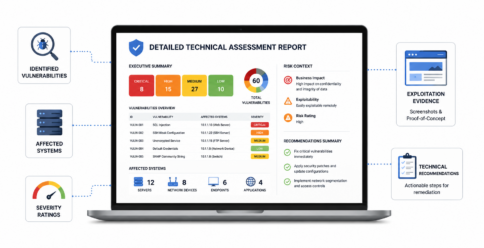
Comprehensive reports include identified vulnerabilities, affected systems, exploitation evidence, severity ratings, and technical recommendations to support remediation planning. Reports are structured to help both technical teams and management understand security priorities clearly. Supporting screenshots, proof-of-concept findings, and risk context improve remediation accuracy and decision-making.
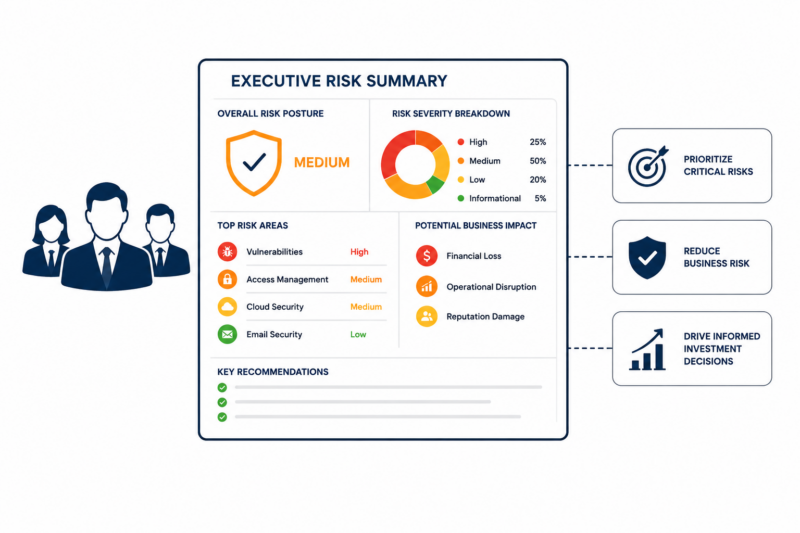
Executive reporting provides leadership teams with a clear understanding of security risks, business impact, and remediation priorities without excessive technical complexity. These summaries highlight critical findings, potential business consequences, and overall security posture. This enables stakeholders to make informed risk management and investment decisions.
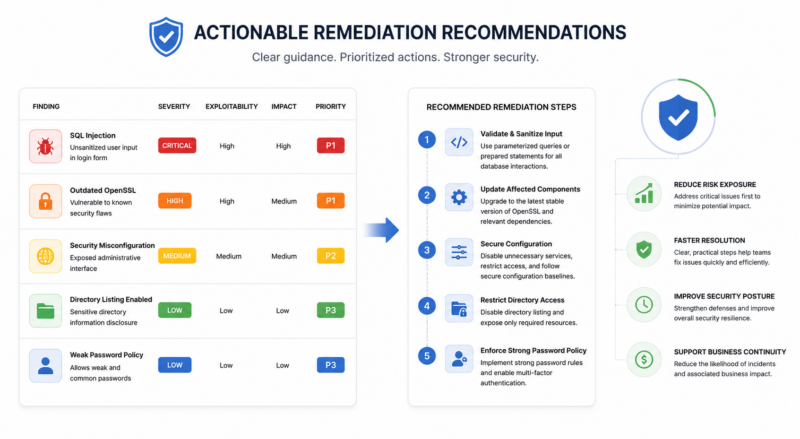
Each finding includes practical remediation guidance designed to help security teams address vulnerabilities efficiently and reduce risk exposure. Recommendations are prioritized based on severity, exploitability, and operational impact. Clear remediation steps help accelerate vulnerability resolution and strengthen long-term security resilience.
Findings are categorized based on risk levels such as Critical, High, Medium, and Low. This classification helps organizations prioritize remediation efforts according to potential business impact and exploitation likelihood.
Risk summaries include business-focused insights that explain how identified vulnerabilities could affect operations, compliance, customer trust, and overall organizational resilience.
Organizations receive guidance for tracking remediation progress and validating corrective actions. This helps ensure vulnerabilities are effectively resolved and security improvements are properly implemented.


At Valency Networks, we advocate for a proactive approach to network security through regular and ongoing VAPT (Vulnerability Assessment and Penetration Testing) engagements. The frequency of network VAPT assessments should be determined based on several factors, including the organization’s industry regulations, compliance requirements, risk tolerance, and the pace of technological change within the network environment. As a best practice, we recommend conducting network VAPT assessments at least annually or more frequently if there are significant changes to the network infrastructure or the threat landscape.<br><br>
Annual assessments help organizations stay ahead of evolving cyber threats, identify new vulnerabilities, and validate the effectiveness of security controls and defenses. In addition to annual assessments, we advise organizations to consider conducting VAPT assessments:
Following major changes to the network infrastructure, such as network upgrades, system deployments, or software updates, it is essential to conduct VAPT assessments to ensure that new vulnerabilities have not been introduced and existing security controls remain effective.
In the event of a security incident or breach, conducting a vulnerability assessment and penetration testing assessment can help identify the root cause of the incident, assess the extent of compromise, and implement remediation measures to prevent similar incidents in the future.
Prior to significant events, such as product launches, mergers and acquisitions, or regulatory audits, conducting VAPT assessments can help ensure that the network infrastructure is secure and compliant with relevant regulations and industry standards.
In addition to periodic assessments, organizations should consider implementing continuous monitoring and testing capabilities to detect and respond to emerging threats in real-time. Continuous VAPT assessments help organizations identify vulnerabilities and security gaps as they arise, enabling proactive remediation and risk mitigation.
By adopting a proactive approach to network VAPT and conducting assessments regularly, organizations can strengthen their cybersecurity defenses, reduce the risk of cyber threats, and safeguard their digital assets effectively. At Valency Networks, we work closely with our clients to develop customized VAPT strategies tailored to their specific needs and objectives, ensuring continuous protection against evolving cyber threats.
Modern network environments consist of interconnected systems, cloud resources, remote access technologies, and critical infrastructure components. Network VAPT Services provide comprehensive security coverage across these environments to help organizations identify weaknesses, validate defenses, and strengthen overall cyber resilience.
Firewalls serve as a critical security boundary for network environments. Assessments evaluate firewall rules, access control policies, segmentation controls, and configuration settings to identify weaknesses that could allow unauthorized access.
Virtual Private Networks (VPNs) are commonly used to support remote work and secure connectivity. Testing identifies insecure configurations, weak authentication controls, and vulnerabilities that may expose remote access infrastructure.
Active Directory environments are reviewed for privilege escalation risks, excessive permissions, insecure configurations, and identity management weaknesses that attackers frequently target.
Segmentation assessments verify whether sensitive systems, critical assets, and business applications are properly isolated from lower-trust network zones to reduce lateral movement risks.
Wireless security assessments identify weak encryption settings, rogue access points, insecure authentication mechanisms, and configuration flaws that could expose internal resources.
Critical servers are evaluated for patching gaps, insecure services, configuration weaknesses, exposed ports, and vulnerabilities that could provide attackers with unauthorized access.
Remote administration tools, VPN gateways, and remote desktop services are tested to identify security weaknesses that could be exploited by external attackers.
Organizations increasingly rely on hybrid environments that connect on-premises infrastructure with cloud services. Assessments evaluate the security of network communication channels and connectivity controls.
Testing focuses on administrative accounts, privileged users, and access management controls to identify excessive permissions and privilege abuse opportunities.
Network VAPT Services validate the effectiveness of existing security controls, helping organizations determine whether firewalls, monitoring solutions, segmentation controls, and access restrictions are functioning as intended.

Founder & CEO, Valency Networks
Prashant Phatak is an accomplished leader in the field of IT and Cyber Security. He is Founder and C-level executive of his own firm Valency Networks. Prashant specializes in Vulnerability assessment and penetration testing (VAPT) of Web, Networks, Mobile Apps, Cloud apps, IoT and OT networks. He is also a certified lead auditor for ISO27001 and ISO22301 compliance.As an proven problem solver, Prashant's expertise is in the field of end to end IT and Cyber security consultancy to various industry sectors.